Caribbean Port Guide
San Juan Port Guide
What to do in San Juan on a cruise port day: the walkable sights, the excursions worth paying for, and what things actually cost. Free to read in full.
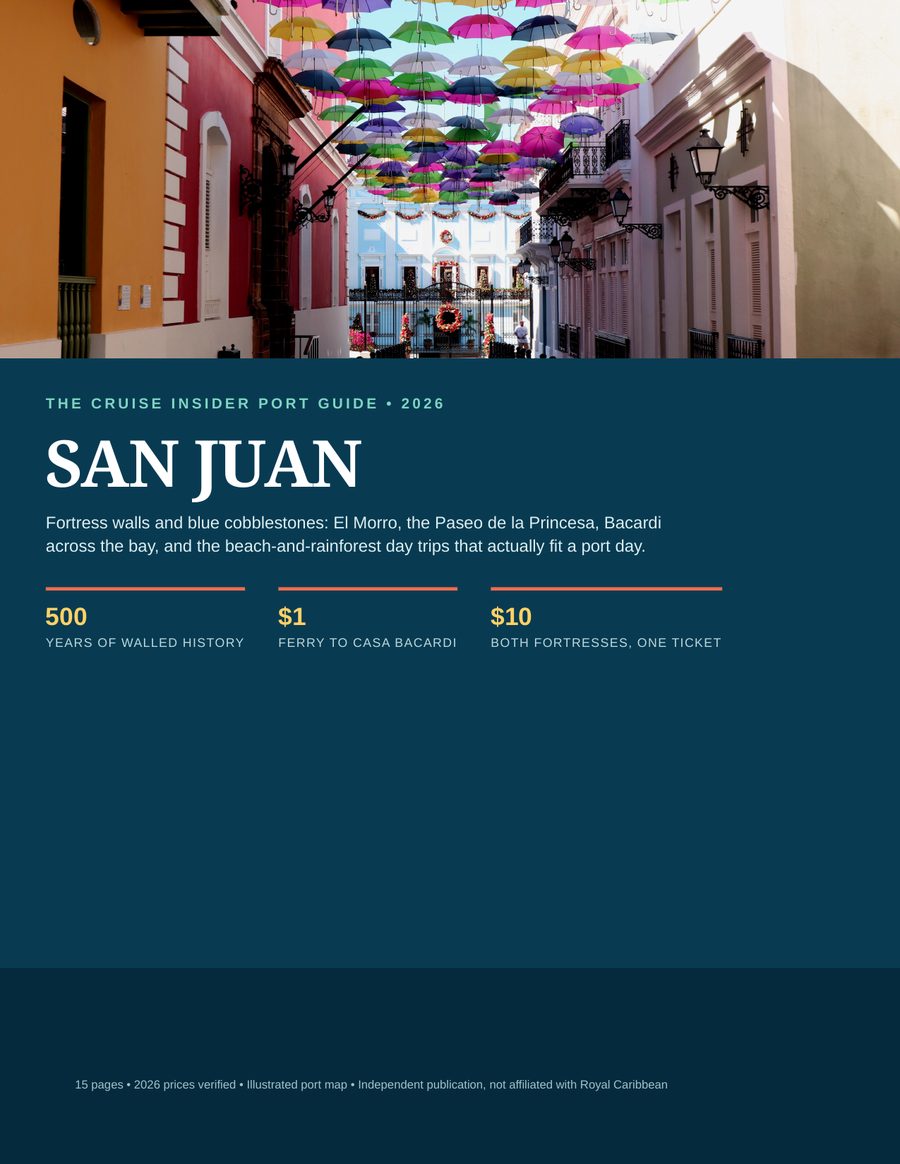
Start here: the five moves San Juan is the Caribbean's most layered port call: a 500-year-old walled city you can walk off the ship into, two fortresses on a single $10 ticket, a rum distillery across a $1 ferry ride, and rainforest and beaches within reach. Five decisions make the port call.
Know which pier you are on
It changes everything. Piers 1, 3, and 4 sit in Old San Juan and the historic district is a walk away. The Pan American Pier sits across the bay and you cannot walk to Old San Juan from it: a taxi or shuttle is required. Check the Royal Caribbean app the night before and plan your first move from the right pier.
Agree every taxi fare before you board
San Juan's tourist taxis run on regulated zone fares, not meters. The fare from your pier to Old San Juan, Condado, or Isla Verde is predetermined: ask the dispatcher or driver for the zone fare before you get in, and confirm it is the total, not per person.
Do Old San Juan first, on foot
The walled city is compact, mostly flat by the water, and best before the heat builds. Walk the Paseo de la Princesa from the piers, climb to El Morro early, and save the shops for the warm middle of the day when the shade and the air conditioning matter.
Book Casa Bacardi ahead
The distillery tours sell out on multi-ship days, and the walk-up line is the slow line. Reserve the Legacy Tour online before you sail, ride the $1 Cataño ferry across the bay, and be back in time to watch Old San Juan recede from the top deck.
Respect the all-aboard time
El Yunque and the far beaches are an hour or more each way, and San Juan traffic clogs in the late afternoon. If your excursion ends after 3 PM, you should be on a ship excursion with a guaranteed return, not in a taxi hoping for green lights.
Final authority: Prices, hours, and ferry schedules change by season. Use this guide to plan; use the Royal Caribbean app and the taxi dispatchers at the pier to confirm on the day.
Inside 03 San Juan at a glance 06 Getting around 09 Top things to do 12 Shopping 15 Checklist + sources
04 Arrival: the cruise piers 07 Best beaches, ranked 10 Excursion prices: ship vs DIY 13 Practical info + safety
Verify times, prices and access in the Royal Caribbean app.
05 Illustrated port map 08 The Old San Juan walk 11 Eat and drink 14 Sample timelines
San Juan at a glance PR
EN+ES
AST
1521
Us Territory:
English And Spanish
Atlantic Standard
The Year The Walled
Dollars, No
Spoken Everywhere
Time, Utc-4, No
City Was Founded
Passport, No
Daylight Saving
Roaming
The quick profile • What it is: the capital of Puerto Rico and the Caribbean's oldest European-founded city still in use. Old San Juan is a walled colonial district of blue cobblestones, pastel buildings, and two Spanish fortresses, sitting on an islet at the mouth of San Juan Bay. The modern city, beaches, and airport spread east along the coast. • Who comes: Royal Caribbean uses San Juan two ways. As a homeport, ships (including Vision and Rhapsody of the Seas in recent seasons) sail from the Pan American Pier across the bay. As a port of call, ships dock at Piers 1, 3, and 4 in Old San Juan itself. Your pier decides your whole day: confirm it in the app. • The deal: this is the rare Caribbean port where the best experience is free and walkable. The forts cost $10 total, the Paseo de la Princesa costs nothing, and the piña colada was (allegedly) invented here. The ship's markup is steepest on El Yunque and Bacardi; the DIY wins are the ferry, the forts, and the walking. • Time: Atlantic Standard Time, UTC-4, no daylight saving. That matches Eastern Daylight Time from March to November, so ship time and local time usually agree. Confirm in the app anyway: the ship's time rules, not the island's. • Money: the US dollar, full stop. This is a US territory, so prices are in dollars, cards work everywhere, ATMs dispense dollars, and your purchases come home as domestic, not duty-free, goods.
Verify times, prices and access in the Royal Caribbean app.
The bay in one paragraph Old San Juan occupies the islet at the northwest mouth of the bay. Piers 1, 3, and 4 line its south shore, with the Paseo de la Princesa running along the water and the fortresses at the point and the east wall. The Pan American Pier sits on the south shore of the bay, facing the old city across the water. Cataño and the Casa Bacardi distillery sit on the west shore of the bay. Condado, Ocean Park, Isla Verde, and the airport run east along the Atlantic coast; El Yunque rises to the east beyond them.
A US port that feels foreign San Juan is the easiest logistics day in the Caribbean for Americans: no passport, no roaming, no currency math. It is also the most culturally distinct: 500 years of Spanish history, a food scene built on plantains and pork, and a walled city that predates the United States by two and a half centuries.
Language: everything a cruiser needs is in English, but a few words of Spanish earn smiles everywhere. Menus are often bilingual; the street vendors appreciate the effort.
Arrival: the cruise piers San Juan has two cruise areas and they are not interchangeable. Old San Juan's piers put you inside the historic district. The Pan American Pier puts you across the bay with a taxi ride between you and everything. Know your pier before the gangway opens. Piers 1, 3, and 4: Old San Juan • Where they are: on the south shore of the Old San Juan islet, right below the city walls. Ships dock sternto or alongside, and you walk off into the historic district. • What's here: the terminals are functional rather than fancy: restrooms, a small shop or two, and taxi stands outside. The real amenity is the location: the Paseo de la Princesa starts steps away. • First move: walk. The Paseo de la Princesa runs west along the water from the piers toward El Morro. The city climbs above you to the right; the bay sparkles to the left. It is the best free first hour in the Caribbean. • Taxis: lined up outside the terminals with regulated zone fares to Condado, Isla Verde, and the airport. Agree the fare before boarding.
Pan American Pier II • Where it is: on the south shore of San Juan Bay, across the water from Old San Juan. Royal Caribbean has used it as a homeport pier; some port-of-call visits dock here too. • The critical fact: you cannot walk from the Pan American Pier to Old San Juan. A taxi transfer is strictly required: the regulated zone fare runs you to the old city in about 10 to 15 minutes without traffic. • What's here: a working cruise terminal with the usual shops, restrooms, and taxi dispatch. For homeport embarkations, this is where the luggage drop and check-in happen.
Homeport vs port of call Starting your cruise in San Juan? Fly in the day before: the old city deserves an evening, and a delayed flight on embarkation day is the classic San Juan disaster. Stay in Old San Juan or Condado, drop bags at the Pan American terminal when it opens, and be back in the boarding queue early: San Juan embarkations are efficient but the lines peak midday.
First 20 minutes • Docked in Old San Juan: walk the Paseo de la Princesa toward El Morro. Fort first, shops later. • Docked at Pan American: taxi to Old San Juan immediately. Every minute at the terminal is a minute off the walls. • Embarking: check bags, keep a day pack with swim gear and documents, and clear security early. Then walk: the old city is right there. • Either way: confirm the all-aboard time before you leave the terminal area, and screenshot it.
Pier check: the Royal Caribbean app lists your docking location the night before. If it says Pan American, budget taxi time both ways and do not plan a walking day.
• First move: taxi straight to Old San Juan if you are in port for the day, or straight to your hotel or the airport if you are ending a cruise. Do not linger: everything worth seeing is across the bay.
Verify times, prices and access in the Royal Caribbean app.
Port map
How to read it: Old San Juan occupies the islet at the northwest mouth of the bay. Cruise Piers 1 to 4 (1) line its south shore below the old town streets (3), with El Morro (2) at the point, San Cristobal (4) at the east end, and the Paseo de la Princesa (5) along the waterfront. The Pan American Pier (6) sits across the bay to the south: a taxi ride, never a walk. Cataño and Casa Bacardi (7) sit on the west shore of the bay, reachable by the $1 ferry. Condado (8), Isla Verde (9), and the airport run east along the Atlantic coast; El Yunque (10) rises beyond them. The map is illustrated and stylized, not to scale. Verify times, prices and access in the Royal Caribbean app.
Getting around Old San Juan is a walking district; everything else is a taxi ride. San Juan's tourist taxis run on predetermined zone fares, which removes the haggling but not the need to confirm the price before you board. The taxi system • What they are: regulated tourist taxis running from stands at the piers, the airport, and the hotel zones. Fares are set by zone, not by meter: the price from your pier to Old San Juan, Condado, Isla Verde, or the airport is fixed and printed on the fare sheet at the stand. • The rules: ask for the zone fare before you get in, and confirm it is the total for the ride, not per person. The fare sheet is your receipt-in-advance: if a driver will not honor it, take the next taxi. • Typical runs: Pan American Pier to Old San Juan is the short hop, about 10 to 15 minutes. Old San Juan to Condado is about 10 minutes, to Isla Verde about 15 to 20, to the airport (SJU) about 15 to 25 depending on traffic. El Yunque is 45 minutes or more: negotiate or book ahead. • Tipping: a dollar or two on the short hops, more on the long ones. Cash is king; some taxis take cards, most prefer not to.
Verify times, prices and access in the Royal Caribbean app.
Other ways around • Walking: Old San Juan is genuinely walkable and mostly flat along the water; the climbs are up to the forts and the cathedral quarter. Nothing else on this map is walkable from the ship. • Cataño ferry: the public ferry from near Pier 2 in Old San Juan to Cataño runs about $1 each way, a 15minute ride across the bay with the old city skyline behind you. It is the cheap and scenic route to Casa Bacardi. • Rental cars: available at the airport and in Condado. Worth it only for El Yunque on a long port day: parking in Old San Juan is tight and the streets are narrow and one-way. • Public buses and the Tren Urbano: cheap but slow and not built for cruise timelines. Skip them on a port day.
The traffic rule San Juan's bridges and causeways clog in the late afternoon, especially the routes to Isla Verde and the airport. Plan to be back in the Old San Juan area 60 to 90 minutes before all aboard, and add 30 minutes if you are coming from El Yunque or Luquillo.
Best beaches, ranked San Juan's beaches are city beaches: easy to reach, well served, and honest about what they are. None of them is a castaway cay, and the Atlantic side can be rough. These five are the ones worth your port-day hours, ranked. Isla Verde Free entry
Condado Beach Free entry
The best all-around beach near the port: a long stretch of golden sand east of the city with the calmest swimming in the San Juan area, beach bars, chair rentals, and hotels lining the shore. Taxi about 15 to 20 minutes from the Old San Juan piers. The default beach day.
The convenient one: a narrow beach behind the Condado hotel strip, 10 minutes from the piers. Pretty to look at, rougher to swim in: the Atlantic surf and undertow here are real, and the swimming is best near the protected pockets. Great for a beachfront lunch and a quick dip.
Best for: swimming, families, the classic beach afternoon
Best for: short port days, people watching, hotel-zone lunch
Escambron Beach Free entry
Ocean Park Free entry
The local favorite near Old San Juan: a small protected cove just east of the old city with calm water, decent snorkeling, and a park with facilities. Walkable-ish from the east end of Old San Juan, a short taxi from the piers. The snorkel-without-a-boat option.
The in-between beach: a wide, quieter stretch between Condado and Isla Verde with a neighborhood feel, kite surfers, and fewer vendors. Calmer than Condado, less built-up than Isla Verde. Best for: a quieter afternoon, kite watching, long walks
Best for: snorkeling, a quick swim near the forts
Luquillo Beach Free entry The day-trip beach: a calm crescent of sand about 45 minutes east, near El Yunque, with the famous kioskos food strip behind it. Worth it only on long port days, ideally paired with a morning in the rainforest. Best for: combining with El Yunque, the kioskos lunch
Chair and umbrella math: about $10 to $20 per chair and $15 to $25 per umbrella at Condado and Isla Verde, sometimes bundled. Atlantic-side rule: swim near the lifeguard flags, respect the red flags, and do not turn your back on Condado's surf.
Verify times, prices and access in the Royal Caribbean app.
The Old San Juan walk Old San Juan is the port day: a walled city you can cross on foot in 30 minutes, with 500 years of history stacked on every block. This is the walk that strings it together, piers to point to fort. The walk, west to east
The two fortresses
• Paseo de la Princesa: start at the piers on the 19thcentury seaside promenade: fountains, public art, street vendors on weekends, and the city walls rising above you. It runs west to the old city gate. Free, flat, and the best opening hour in the Caribbean.
• El Morro (Castillo San Felipe del Morro): the point fortress at the northwest tip: six levels of 16th-century walls, the iconic sentry boxes (garitas), and a vast green esplanade made for picnics and kite flying. The views run from the Atlantic to the bay to the city.
• Puerta de San Juan: the old city gate at the end of the Paseo, where ships' passengers once entered the walled city. Walk through it and climb toward the cathedral quarter.
• Castillo San Cristóbal: the east-end fortress, built to repel land attacks: tunnels, dungeons, and sweeping views back over the old city. Bigger and more mazelike than El Morro.
• Catedral de San Juan: the second-oldest cathedral in the Americas, holding the tomb of Ponce de León. Modest outside, historic inside; a 15-minute stop.
• The ticket: $10 per adult covers both forts for two consecutive days; under 15 free. Hours are 9 AM to 5 PM daily; the forts are cashless, so bring a card. Start at whichever fort is closer to your pier.
• Calle Fortaleza: the shopping street that once hosted the famous umbrella canopy. The umbrellas were taken down a few years ago and the installations rotate, so go for the street itself: colonial balconies, galleries, and the governor's mansion (La Fortaleza) at the far end, which you can only admire from outside. • Plaza Colón and the east wall: the Columbus plaza at the east gate anchors the walk to Castillo San Cristóbal, the landward fortress guarding the city's east side.
Verify times, prices and access in the Royal Caribbean app.
• How long: 60 to 90 minutes each if you read the exhibits, 45 if you walk the walls for the views. The esplanade in front of El Morro is worth 30 minutes by itself.
The timing trick Do the forts in the morning when they open: cooler, quieter, and the light on the walls is the day's best. Save Calle Fortaleza and the shops for midday, when the shade and the air conditioning are the attraction.
Top things to do Beyond the walls, San Juan sells rum, rainforest, and water. These are the activities worth your hours, in the order a cruiser should consider them. Rum and water • Casa Bacardi: the world's most famous rum distillery sits in Cataño, across the bay. The Legacy Tour (around $45) covers the history, the distilling, and the tasting; book online before you sail because it sells out on multi-ship days. No one under 18 is admitted to the experiences. Getting there: the $1 public ferry from near Pier 2 in Old San Juan, then a short taxi or the distillery shuttle. Skip the bundled ferry-and-shuttle packages with rigid timing: the public ferry plus a taxi is cheaper and more flexible. • Catamaran sails: half-day sails from the San Juan area with snorkel stops, open bar, and coastline views. The calm-water alternative to the fort climbs. See the price table on the next page. • Snorkel and dive: Escambron Beach covers the casual snorkel; dive shops run boat trips to reefs and wrecks for certified divers. Book ahead in high season.
The rainforest • El Yunque National Forest: the only tropical rainforest in the US National Forest system, about 45 to 60 minutes east: waterfalls, the Yokahú Tower views, coqui frogs, and 240 tree species. This is a half-day minimum commitment: go early, and only on port days of seven hours or more.
Town and views • La Perla: the colorful seaside neighborhood below the north walls, famous from murals and music videos. Admire it from the walls above; do not wander down uninvited or alone. Guided street-art walks are the respectful way in. • Paseo de la Princesa at sunset: if your ship sails late, the promenade at golden hour is the send-off: the walls glow, the bay fills with light, and the sail-away views from the top deck start here. • Museo de las Américas: the museum of the Americas in the old Cuartel de Ballajá barracks: Puerto Rican and Caribbean history and folk art. A 60minute air-conditioned stop near El Morro.
The Bacardi timing trick Book the earliest distillery tour of the day, ride the morning ferry over, and be back in Old San Juan by early afternoon. The afternoon tours bunch up with the ship excursions, and the last ferry back always feels later than it is.
• How to go: ship excursions run it with a guaranteed return; independent tours run $50 to $80; a rental car works if you are comfortable driving in Puerto Rico. The forest's main recreation areas sometimes require timed reservations: check before you go.
Verify times, prices and access in the Royal Caribbean app.
Excursion prices: ship vs DIY San Juan's ship excursions carry the standard Caribbean markup, and the DIY alternatives are unusually strong: a $1 ferry, a $10 fort ticket, and a walkable old city. This table is the price reality check. Experience
Ship price (typical)
DIY price (typical)
El Yunque rainforest (half day)
$85-$115
$50-$80 independent tour
Casa Bacardi with transport
$75-$95
$2 ferry + $45 tour
Old San Juan walking tour
$60-$75
Free self-guided
Catamaran snorkel sail (half day)
$90-$120
$70-$95 independent
Isla Verde beach break
$55-$75
$15-$20 taxi + free beach
Both forts
Bundled in tours
$10 both, two days
When the ship wins • El Yunque on a tight day: under seven hours in port, the guaranteed return of a ship excursion is worth the premium. The forest is an hour each way and traffic is unforgiving. • First-timers who want zero logistics: the ship's old city tour removes every decision, though the city is easy enough to walk alone. • Multi-ship days at Bacardi: the ship holds its own tour allocation when the public bookings sell out.
Verify times, prices and access in the Royal Caribbean app.
When DIY wins • The forts: always. Ten dollars, two days, both fortresses: no excursion needed. • Casa Bacardi: usually. The public ferry plus a direct booking undercuts the ship by $25 or more for the identical tour. • Beaches: always. A taxi and a free beach beat any beach excursion by $40 or more per person.
The booking rule: book Bacardi's Legacy Tour online before you sail, especially December to April. In summer and fall, the forts and the Paseo need no booking at all.
Eat and drink Puerto Rican food is the day's sleeper hit: plantains, slow-roasted pork, and fritters, plus the drink the whole world associates with the Caribbean. Lunch in Old San Juan is the main event; plan the forts around it. Mofongo
Barrachina
Everywhere in Old San Juan • local prices. The island's signature dish: green plantains mashed with garlic and pork cracklings, molded and served with broth, shrimp, or chicken. Order it once; judge every version after. The trifongo (plantain, yuca, and sweet plantain) is the advanced move.
Calle Fortaleza • tourist prices. The Old San Juan restaurant that claims to be the birthplace of the piña colada (bartender Ramon Marrero, 1963). The Caribe Hilton makes a rival claim, and the truth is lost to rum history: go for the story, the courtyard, and the frozen original.
La Casita Blanca
Alcapurrias and bacalaitos
Santurce • local prices. The beloved creole kitchen a short taxi from the old city: daily-changing Puerto Rican home cooking in a white house with a garden. The lunch the locals drive across town for.
Street carts and kioskos • cheap. The fritter course: stuffed plantain or yuca fritters and codfish pancakes from carts along the Paseo and at the Luquillo kioskos. Eat them hot, standing up, with a cold Malta or coconut water.
Lechón at Guavate
Piraguas
Only with wheels • local prices. The pork highway in the mountains south of San Juan: whole roast pig, roadside, weekends. Not a port-day plan without a rental car, but the legend every food lover should know.
Street carts • a dollar or two. Shaved ice in tropical flavors from the pushcart vendors: the cheapest cooldown in Old San Juan. Coconut and tamarind are the connoisseur picks.
What to try • Mofongo: the plantain mound; get it with camarones (shrimp) at least once. • Piña colada: at Barrachina for the story, anywhere else for the drink.
Water: tap water is safe throughout San Juan. Drink more than you think: the sun between the forts is relentless and the sea breeze hides the burn.
• Medalla Light: the local beer; order it cold with fritters. • Flan de queso: cheese flan, the dessert that converts skeptics.
Verify times, prices and access in the Royal Caribbean app.
Shopping Old San Juan shops like a colonial capital that knows cruise ships: galleries, rum, crafts, and jewelry on the blue cobblestones. Shop with a list, not with wanderlust. Where to shop • Calle Fortaleza and Calle del Cristo: the two main shopping streets: galleries, boutiques, cigar shops, and souvenir stores in restored colonial buildings. Start at the top of Fortaleza and work down toward the bay. • Plaza de la Catedral quarter: the streets around the cathedral hold the smaller galleries and artisan shops: santos (carved saints), vejigante masks, and local art. The most character per block. • Paseo de la Princesa vendors: weekend artisan stalls along the promenade: jewelry, crafts, and art at fair prices. Weekdays are quieter. • Condado and Isla Verde: hotel-zone shops and malls for anything you forgot: sunscreen, beach gear, and American retail. Not a souvenir destination.
The duty-free reality check San Juan is not a foreign port for US shoppers: Puerto Rico is a US territory, so your purchases come home as domestic goods with no customs allowance to track. Prices are fair but not dutyfree-foreign-port cheap: buy the rum and the crafts because they are local, not because they are a steal.
Shop smart: the honest galleries put prices on everything; the pushy cigar shops offer "free" tastings that end at the register. The cathedral quarter rewards browsers; Fortaleza rewards buyers with a list.
What is actually worth buying • Rum: Bacardi, Don Q, and the smaller labels at island prices. Puerto Rican rum is the souvenir that survives the flight home. • Vejigante masks: the bright carnival masks of Ponce and Loiza: genuine folk art, packable in the small sizes. • Santos and crafts: carved saints and local art from the cathedral-quarter galleries. Buy from the working studios, not the import shops. • Coffee: Puerto Rican coffee (Yaucono, Alto Grande) is excellent and cheap. The bags are light and the mornings back home will thank you.
Verify times, prices and access in the Royal Caribbean app.
Practical info + safety San Juan is the lowest-friction port day in the Caribbean for US travelers: domestic in every way that matters, with a few island quirks worth knowing before you walk off the ship. Time, money, and connection • Ship time rules: San Juan is on Atlantic Standard Time (UTC-4), no daylight saving, which matches Eastern Daylight Time from March to November. The ship stays on its own time regardless: confirm the allaboard time in the app, and set a phone alarm in ship time. • ID: this is a US territory. US citizens need no passport for a closed-loop cruise that starts and ends in the US; a government photo ID is enough ashore. Non-US citizens should carry their passport and check their documentation. • Cell service: domestic. US plans treat Puerto Rico like the mainland: no roaming charges, full data. Download offline maps anyway: the old city's stone walls eat signal in spots. • Cash: dollars everywhere, cards accepted widely. Taxis, street carts, and market stalls prefer cash; break bills at the pier.
Sun, sea, and streets • Heat: San Juan is hot year-round with real humidity. The fort climbs are exposed: go early, carry water, and use the midday for shaded streets and air-conditioned museums. • Surf: the Atlantic side (Condado especially) has genuine undertow. Swim near the lifeguard flags, respect red flags, and keep children close at Condado.
Safety • Daytime: Old San Juan, the Paseo, Condado, and Isla Verde are busy and comfortable. The standard rules apply: watch your bag on the beach, do not flash cash, and keep the cabin safe for documents. • La Perla: the seaside neighborhood below the north walls is a real residential community, not a tourist attraction. Admire it from the walls; do not wander in alone or uninvited. Guided walks are the respectful option. • After dark: stick to well-lit streets in the old city and the hotel zones. Do not wander unlit roads or empty beaches at night. • Scams: the common ones are the "free" bracelet that is not free, the unlicensed driver quoting double at the pier, and the timeshare pitch dressed as a tour. Use the taxi stands, agree the zone fare, and keep walking past the bracelet sellers.
What to bring ashore Government photo ID, cash in small bills, reefsafe sunscreen, hat, grippy shoes for the cobblestones, swim gear if the beach is on the plan, a dry bag for the ferry day, and a portable charger. Screenshot the all-aboard time and your pier.
• Cobblestones: Old San Juan's blue adoquines are beautiful and slippery when wet. Wear shoes with grip, not smooth sandals, especially after rain. • Rain: tropical showers pass fast. A compact poncho beats an umbrella on the windy walls.
Verify times, prices and access in the Royal Caribbean app.
Sample timelines Three ways to run the day, depending on your pier and your group. Pick one the night before and commit: San Juan rewards the walker with a plan. The fortress day (docked in Old San Juan) 9:00 off the ship and onto the Paseo de la Princesa, walking west to the old city gate. 9:45 climb to El Morro as it opens: walls, garitas, and the esplanade. 11:30 walk the wall-top streets to Castillo San Cristóbal on the same $10 ticket. 1:00 lunch in the old city: mofongo and a piña colada at Barrachina for the story. 2:30 Calle Fortaleza and the cathedral quarter for shopping and galleries. 4:00 piragua on the Paseo, then back aboard. Total extra spend: lunch, the $10 fort ticket, and souvenirs.
The rum and walls day (any pier, 7+ hours) 9:00 taxi or ferry to Casa Bacardi: book the earliest Legacy Tour online before you sail. 9:30-11:30 distillery tour and tasting. 12:00 $1 ferry back across the bay (or taxi from Cataño) into Old San Juan. 12:30 lunch: alcapurrias from a cart, then mofongo. 2:00 El Morro and the esplanade on the $10 ticket. 3:30 Paseo de la Princesa stroll back toward the piers. Buffer rule: if you docked at Pan American, leave the old city 90 minutes before all aboard for the taxi back.
The beach and rainforest day (8+ hours only) 8:30 off the ship: pre-booked independent tour or rental car to El Yunque. 9:30-12:30 waterfalls, Yokahú Tower, and the visitor center. 1:00 lunch at the Luquillo kioskos: fritters and a cold Medalla. 2:00-3:30 swim at Luquillo Beach or drive back to Isla Verde. 4:00 wheels pointed at the pier, no stops. This day has no slack: on a ship excursion the return is guaranteed, on your own it is not.
Embarkation-day version: starting your cruise in San Juan? Do the fortress day in reverse the day before you sail: fly in early, walk the walls in the afternoon, sleep in Old San Juan or Condado, and board when the terminal opens. The ship can wait; your flight cannot.
Verify times, prices and access in the Royal Caribbean app.
Checklist + sources The night before
What to bring ashore
• Which pier? Confirmed in the app: Old San Juan or Pan American
• Government photo ID (passport only if you are not a US citizen)
• Walls, rum, or rainforest? Decide on the port hours
• Cash in small bills for taxis, carts, and the Cataño ferry
• Casa Bacardi Legacy Tour booked (if doing it) • El Yunque transport booked (if doing it) • All-aboard time confirmed in the app, alarm set in ship time
• Reef-safe sunscreen, hat, sunglasses • Grippy shoes for the blue cobblestones • Swim gear and a dry bag if the beach is on the plan • Nothing you cannot afford to lose
Money savers
Keep planning
• Walk Old San Juan: the best sights are free • Take the $1 ferry to Bacardi, not the $75 ship transfer • One $10 ticket covers both forts for two days • Eat at the carts and kioskos: the best lunch is also the cheapest
• Pair this guide with your ship guide for the full sailing plan • Watch for more Cruise Insider port guides at cruiseguides.gumroad.com: Falmouth, Grand Cayman, St. Kitts, and Barbados are next
Your San Juan day, planned. Walk off the pier knowing which side of the bay you are on and where the mofongo is, and make San Juan the day you talk about all cruise. Sources • San Juan cruise pier operations: Old San Juan Piers 1, 3, 4 and Pan American Pier II assignments (2026-27 season data) • National Park Service: San Juan National Historic Site admission, hours, and cashless policy • Casa Bacardi: Legacy Tour pricing, advance booking, and age policy; Cataño public ferry fare • Puerto Rico Tourism Company: regulated tourist taxi zone fares; USDA Forest Service: El Yunque recreation policies • Traveler reports on Calle Fortaleza street installations (2025-2026)
Photo credit Cover photo: "Old San Juan Umbrella Street" by Jorge Rodriguez, CC BY 2.0, via Wikimedia Commons (2019; the umbrella installation has since been removed and displays rotate). Port map is original artwork created for this guide. Independent publication: This guide is an independent publication, not affiliated with or endorsed by Royal Caribbean. Port facts were researched from public sources in September 2026; prices, hours, and schedules change, so always verify before booking. Verify times, prices and access in the Royal Caribbean app.