Caribbean Port Guide
Grand Cayman Port Guide
What to do in Grand Cayman on a cruise port day: the walkable sights, the excursions worth paying for, and what things actually cost. Free to read in full.
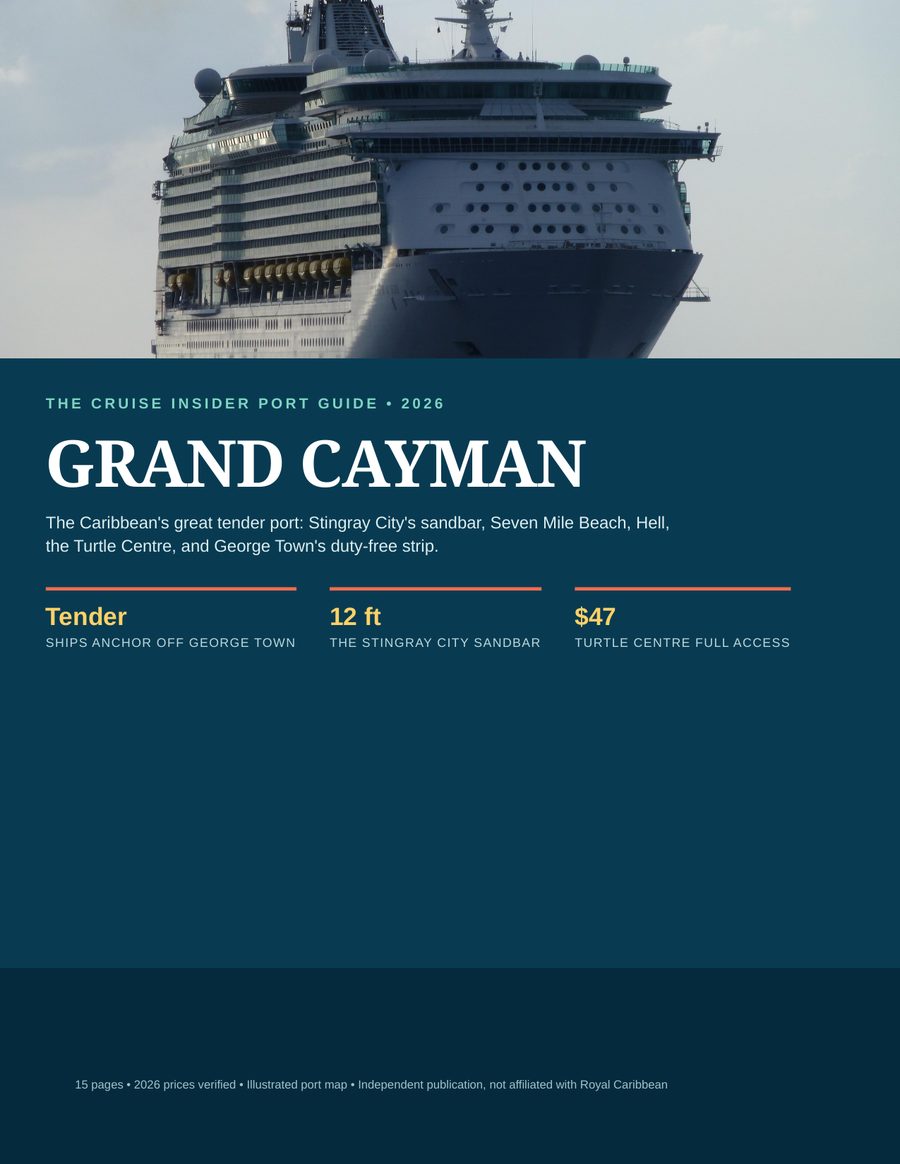
G R A N D C AY M A N
Start here: the five moves Grand Cayman is the Caribbean's great tender port: your ship anchors off George Town and small boats ferry you ashore, which adds a real hour to each end of the day. The island itself is easy, English-speaking, and built for visitors. Five decisions make the port call.
Budget the tender like an excursion
The ride is 5 to 15 minutes, but the queue is the day. With three or four ships anchored, 60 to 90 minutes each way is normal at peak times. Get in the tender line early, and plan to be back at the pier a full hour before the last tender, not a full hour before all aboard.
Agree every taxi fare before you board
Cayman taxis run on government-regulated zone fares, not meters, and shared vans quote per person. Get the number from the dispatcher, confirm per person vs per car and one way vs round trip, and set the pickup time for the return before you leave.
Pick one coast for the day
Seven Mile Beach, the Stingray City and Rum Point circuit, and the East End are three different directions. You cannot do all three in one port day. Pick the morning of, based on your tender time and the sea conditions, and commit.
Do Stingray City in the morning
The sandbar is calmer, clearer, and emptier before noon, and the light is better for photos. Afternoon winds chop up the North Sound and the flotilla of tour boats peaks. The first boats out get the best water.
Let the ship carry the risk on short days
Ship excursions get priority tendering off the ship and a guaranteed return, which matters when the tender queue is the bottleneck. On a short port day, the Stingray City markup buys you the one thing DIY cannot: the ship waits for its own tours.
Final authority: Prices, hours, and sea conditions change by season. Plan with this guide; confirm with the Royal Caribbean app and the tender staff on the pier.
Inside 03 Grand Cayman at a glance 06 Getting around 09 Top things to do 12 Shopping 15 Checklist + sources
04 Arrival: the tender port 07 Best beaches, ranked 10 Excursion prices: ship vs DIY 13 Practical info + safety
Verify times, prices and access in the Royal Caribbean app.
05 Illustrated port map 08 The George Town walk 11 Eat and drink 14 Sample timelines
G R A N D C AY M A N
Grand Cayman at a glance 1503
12 ft
1968
1.20
The Year Columbus
The Depth Of The
The Year The Turtle
Us Dollars To One
First Sighted The
Stingray City
Centre Opened
Cayman Dollar, Fixed
Islands
Sandbar
The quick profile • What it is: the largest of the three Cayman Islands, a British Overseas Territory in the western Caribbean, about 90 miles south of Cuba. Capital: George Town. The economy runs on offshore finance, diving tourism, and beaches: expect excellent infrastructure, high prices by Caribbean standards, and an island set up for visitors. • Who comes: Western Caribbean sailings, often paired with Cozumel and Falmouth. Grand Cayman is the bucket-list stop on that triangle: the stingrays, Seven Mile Beach, and the duty-free shopping are the three reasons ships keep coming back. • The deal: the hardest arrival and the easiest island. The tender eats an hour at each end, but once ashore everything is close, English-speaking, and on regulated taxi fares. The ship's markup is steepest on Stingray City; the DIY wins are the beaches, Hell, and the town walk. • Time: Grand Cayman is on Eastern Standard Time (UTC-5) all year, no daylight saving: one hour behind US Eastern Daylight Time from March to November. If your ship stays on Eastern time, local clocks read an hour earlier. The ship's time rules, not the island's. • Money: the Cayman Islands dollar (KYD), fixed at about 1.20 US dollars and printed in colorful bills you will want to photograph. US dollars are accepted everywhere ashore, but change often comes back in Cayman dollars. Cards work at nearly every tourist business.
Verify times, prices and access in the Royal Caribbean app.
The island in one paragraph Grand Cayman is a long, low island shaped like a sideways comma. West Bay, north of the port, holds Hell, the Turtle Centre, and the USS Kittiwake wreck offshore. Seven Mile Beach runs north from George Town along West Bay Road, lined with resorts and public access points. George Town is the tender landing and the dutyfree strip. South of town: Smith Cove and quiet South Sound. The middle runs east through Bodden Town, the first capital, past Pedro St. James, to the North Side: the Botanic Park, Rum Point, and Starfish Point on the calm North Sound. The far East End is rugged coast and blowholes.
The tender port paradox Grand Cayman is the port most likely to test your patience and the island least likely to test your planning. The tender queue is the whole game: once you beat it, the island is flat, compact, English-speaking, and priced on a government fare card. Win the morning and the day runs itself.
Language: English is the official language and everyone in the tourist trade speaks it. You will hear a Caymanian lilt with its own expressions; a friendly greeting goes a long way. Driving is on the left, British style.
G R A N D C AY M A N
Arrival: the tender port There is no pier in Grand Cayman: your ship anchors in George Town Harbour and tender boats run you ashore. The ride is short and the view of the ship from the water is one of the best photos of the cruise. Everything else about the arrival is queue management. The anchorage and the terminals • Where you land: at one of three tender terminals on Harbour Drive in downtown George Town: the Royal Watler Cruise Terminal or the North or South terminals, a few hundred meters apart. There is no big enclosed terminal building: you step off the tender onto the waterfront, where shaded tents, tour meeting points, and taxi dispatchers are set up. • The ride: 5 to 15 minutes each way in normal conditions, running continuously. The last tender back is typically 30 to 60 minutes before all-aboard: confirm the exact time in the app, because missing it is missing the ship. • The queue: this is the real arrival. Tender boats hold 100 to 150 people, and with three or four large ships anchored at once, 10,000-plus passengers share the system. Morning queues of 30 to 60 minutes are common; 90 minutes happens on the busiest days. • Sea conditions: Grand Cayman is the Caribbean port most likely to be skipped for weather. If the swell makes tendering unsafe, the captain cancels, sometimes at the last minute. Do not pre-pay nonrefundable tours without a weather cancellation policy.
First 20 minutes • Ship excursion booked: follow the priority tendering instructions: usually a meeting point in a lounge, then straight onto a tender. Confirm the return time before you leave.
The multi-ship math One ship in the anchorage: a smooth 20-minute tender cycle. Four ships: 12,000 people sharing small boats. Check how many ships are in port on your day. On a four-ship day, start 30 minutes earlier than you think you need to, in both directions.
The tender queue, managed • How it works: on busy mornings the crew distributes numbered tender tickets in a lounge, then calls groups in order. Collect your whole party's tickets together and wait for your number. • Going back: no tickets for the return, just a queue at the terminal, and the late-afternoon line is the longest of the day. Leave the beach or the tour with time to spare. • Mobility: tenders require stepping onto a moving boat and climbing boat ladders. If anyone in your party has mobility limits, talk to guest services early about whether tendering is safe that day.
Pier check: the three terminals sit within a few hundred meters of each other on Harbour Drive, but on a busy day it is easy to queue at the wrong one for your ship. Check the ship name on the tender before you board, in both directions.
• DIY day: join the tender queue early: the first hour ashore is when Stingray City boats depart and the beach taxis are plentiful. Note which terminal your tender uses, so you return to the right pier. • Staying in town: you are already there: the shops, the museum, and the waterfront are minutes from the terminals. Verify times, prices and access in the Royal Caribbean app.
G R A N D C AY M A N
Port map
How to read it: Your ship anchors off George Town (2) in the southwest: the tender anchorage (1) is a 5 to 15 minute ride to the waterfront terminals, but the queue is the day. Seven Mile Beach (3) runs north along West Bay Road, with the Turtle Centre (4) and the Hell rock formation (5) further into West Bay. Boats cross the North Sound to the Stingray City sandbar (6); Rum Point (7) and Starfish Point (8) sit on the sound's northeast shore, and the Botanic Park (9) inland. Smith Cove (10) is the local swim spot on the south coast just east of town, and the blowholes (11) are at the far East End. Taxis run on regulated zone fares: agree every fare before you board. The map is illustrated and stylized, not to scale. Verify times, prices and access in the Royal Caribbean app.
G R A N D C AY M A N
Getting around The island is flat, the roads are good, and the taxis run on governmentregulated zone fares instead of meters. Once you are past the tender queue, getting around is the easiest part of the day. The taxi system • What they are: licensed taxis queue right outside the tender terminals, usually organized by dispatchers. Fares are set by a government zone schedule based on distance and passenger count: no meters, no haggling over the route, but always confirm the fare before you board. • The rules: confirm whether the quote is per person or for the whole car, one way or round trip, and agree the pickup time and place for the return. Shared vans to the beaches quote per person; a private car for your group quotes per vehicle and often wins for families. • Typical runs: Seven Mile Beach is 10 to 15 minutes north: shared vans run about $6 to $15 per person each way, private cars about $25 to $35 per vehicle. Hell and the Turtle Centre are 15 to 20 minutes into West Bay. Rum Point is 45 minutes or more across the island; the Botanic Park and East End are 40-plus minutes east. The far runs cost real money: get the round-trip number up front. • Round trips: for anywhere beyond Seven Mile Beach, book the driver for the round trip with a set pickup time. One-way taxis strand cruisers at Rum Point and the Botanic Park every week. • Tipping: 10 to 15 percent for good service, more for a driver who waits or narrates. Cash, in US dollars or Cayman dollars.
Verify times, prices and access in the Royal Caribbean app.
Other ways around • Public minibuses: the local buses run fixed routes along West Bay Road to Seven Mile Beach and West Bay, and east toward Bodden Town. Fares are a few dollars in cash. Cheap and authentic, but they run on island time, not cruise time. • Walking: downtown George Town is flat and compact: the terminals, the duty-free shops, and the museum are all walkable. Nothing else on this map is walkable from the ship: Seven Mile Beach starts a 30-minute walk north in the heat. • Rental cars: available near the port, but you drive on the left and the port-day math rarely favors it: by the time you clear the paperwork, a taxi has you on the beach. • Ship shuttles: some beach excursions include transfers. Confirm the return time in writing: the shuttle back is the one that matters.
The West Bay Road rule West Bay Road is the two-lane spine between George Town and Seven Mile Beach, and on a four-ship day it crawls. Ten minutes on the map becomes 25 in traffic. Leave the beach 90 minutes before the last tender, and do not schedule anything north of the Turtle Centre or east of Bodden Town after 2 PM unless the ship guarantees the return.
G R A N D C AY M A N
Best beaches, ranked Grand Cayman sells the Caribbean's most famous beach address, and the whole Seven Mile strip has public access: no resort wristband needed. These are the beaches worth your port-day hours, ranked by sand quality divided by taxi time. Seven Mile Beach: Public Beach Free entry
Governor's Beach Free entry
The main public access section, mid-beach: the classic crescent of white sand and clear shallow water, with restrooms, changing rooms, and chair and umbrella rentals nearby. This is the postcard, and it delivers. Arrive before 10 AM for the calmest water and the pick of the sand.
A quieter public access point south of the main section, near the Governor's residence: same famous sand, fewer crowds, less infrastructure. Bring your own towel and shade. The insider pick when Public Beach feels busy. Best for: a quieter swim on the same famous sand
Best for: the classic Cayman beach day, first-timers, facilities
Cemetery Beach Free entry
Smith Cove Free entry
The north-end locals' beach, named for the small cemetery across the road: excellent snorkeling off the rocky points, calm mornings, and a fraction of the crowds. No facilities, so pack in and pack out.
The local favorite just south of George Town: a small, sheltered cove with clear water, shade trees, and picnic tables. Five minutes from the tender terminals by taxi, which makes it the best beach math on a short port day.
Best for: snorkeling from shore, escaping the crowds Best for: short days, a quick swim near town, shade
Rum Point Beach Free entry Not Seven Mile at all: a calm, shallow North Sound beach on the island's north side, with hammocks, the famous Wreck Bar, and water you can stand in for a hundred yards. Worth the 45-minute drive only if you have the hours: pair it with Stingray City. Best for: calm wading, the mudslide, a half-day escape
Chair and umbrella math: about $15 to $25 per chair and $20 to $30 per umbrella at the serviced sections. Bring cash and reef-safe sunscreen. The beach-vendor rule: a polite, firm "no thank you" works; engaging in the pitch starts the negotiation.
Verify times, prices and access in the Royal Caribbean app.
G R A N D C AY M A N
The George Town walk George Town is a working capital that happens to take cruise ships: banks and law firms upstairs, duty-free jewelry below, and the whole thing walkable from the tender in minutes. This is the walk for the hours between the tender and the beach. The walk, pier to fort
Guided or solo
• Harbour Drive waterfront: step off the tender and you are on it: the working harbor with the anchored ships behind you, pastel storefronts ahead, and the whole duty-free strip within sight. Walk north along the water for the views back at your ship.
• Solo: George Town is flat, compact, and easy to navigate alone: the waterfront is one straight line and everything of interest sits within a 15-minute walk of the terminals. An hour covers the museum and the main shopping streets at a stroll.
• The duty-free arcades: the main shopping streets run a block or two inland from the waterfront: jewelry, watches, china, crystal, and perfume at prices that undercut the US on luxury brands. Even if you buy nothing, the window shopping is the town's main sport.
• Heritage tours: local guides run walking tours covering the town's history as a turtling and seafaring settlement turned finance center. Worth it if you want the stories behind the pastel facades.
• Cayman Islands National Museum: on Harbour Drive in the old courthouse building: the island's story from seafarers and turtlers to finance, in airconditioned comfort. Small, well done, and the best 45 minutes of context on the island. • Fort George: the remains of the 1790 fort on the waterfront: a couple of walls and cannons, free, with harbor views. Five minutes of history and the photo of the day. • Elmslie Memorial Church: the waterfront church with the ship models hanging inside, a nod to the seafaring heritage. Worth a look if the door is open.
Verify times, prices and access in the Royal Caribbean app.
• Camana Bay: the ten-minute add-on north of town: a planned waterfront town with shops, restaurants, a 75foot observation tower, and a cinema. The polished contrast to old George Town; pair it with a Seven Mile Beach afternoon.
The timing trick Do the town in the first hour ashore, when the shops open and the streets are quiet, or in the last hour before the tender, when the beach crowds have left and the light is good on the harbor. Midday belongs to the water: George Town's shade is thin and the sun is direct.
G R A N D C AY M A N
Top things to do Grand Cayman sells wildlife encounters you cannot get anywhere else: standing in the sea hand-feeding stingrays, swimming with farmed green turtles, and diving a purposely sunk Navy ship. These are the activities worth your hours, in the order a cruiser should consider them. The stingrays and the sea • Stingray City sandbar: the signature excursion: a shallow sandbar in the North Sound, reachable only by boat, where southern stingrays gather in waistdeep water. You stand on the sand while the rays glide around you; guides show you how to feed them squid and hold one gently for the photo. Tours run 1.5 to 4 hours; morning departures get the calmest water and fewest boats. Do the stingray shuffle: slide your feet instead of stepping, so you never step on a ray. • USS Kittiwake wreck: a former US Navy submarine rescue ship, sunk deliberately in 2011 as an artificial reef off West Bay. Divers swim the bridge and decks; snorkelers circle the upper structure. The signature dive in the Cayman Islands and one of the Caribbean's best wreck snorkels.
West Bay: Hell and the turtles • Hell: a field of jagged black limestone in West Bay, free to visit, that looks like the surface of another planet. The whole stop takes 15 minutes: walk the short viewing platform, send the postcard ("Greetings from Hell"), browse the gift shop. Combine it with the Turtle Centre, five minutes away. • Cayman Turtle Centre: the former Cayman Turtle Farm, opened in 1968: part conservation facility, part water park. Full access ($47 adult, $27 child) includes the lagoon where you swim and snorkel with green sea turtles. Land-only admission ($30 adult, $21 child) covers the exhibits without the swim. Book the morning for the clearest water.
Verify times, prices and access in the Royal Caribbean app.
The quiet side: north and east • Rum Point: the North Side beach club scene: calm, knee-deep water, hammocks, and the Wreck Bar's famous mudslide. The drive is 45 minutes each way, so it only works as a half day: the classic pairing is a morning Stingray City tour that ends at Rum Point for lunch. • Starfish Point: minutes from Rum Point: a calm, shallow beach scattered with orange cushion starfish. Wade, look, photograph, and do not lift them out of the water. • Queen Elizabeth II Botanic Park: the island's garden showpiece on the North Side: orchids, heritage gardens, and the Blue Iguana Conservation facility. Admission is $25 adult, $12.50 child. The drive is 40 minutes from the port: a full morning for garden lovers and repeat visitors. Bring mosquito repellent. • Bodden Town and Pedro St. James: the island's first capital and its oldest great house, the 1780 stone "castle" called the birthplace of democracy in the Cayman Islands. A 30-minute history stop on an eastend driving tour. • East End blowholes: the rugged far east coast, where the sea fires through holes in the ironshore rock. Free and dramatic: the payoff for the long drive east, usually bundled with the Botanic Park on island tours.
The Stingray City timing trick Book the earliest boat of the day. The sandbar at 8:30 AM is a different place than at 1 PM: glassy water, a handful of boats, rays that have not been fed by forty tourists yet. By midday the flotilla peaks and the water clouds. The excursion costs the same either way; the morning is simply better.
G R A N D C AY M A N
Excursion prices: ship vs DIY Grand Cayman is the priciest port in the Western Caribbean, and the ship excursions carry the standard markup on top. The DIY alternatives are strong wherever a taxi or a tour boat can reach. This table is the price reality check. Experience
Ship price (typical)
DIY price (typical)
Stingray City, 3-stop tour (half day)
$85-$115
$55-$85 direct + $20-$30 taxi share
Turtle Centre full access
$70-$100
$47 entry + $15 taxi share
Hell + West Bay sightseeing
$50-$75
Free + $15 taxi share
Botanic Park + East End tour
$90-$120
$25 entry + $40 taxi share
Seven Mile Beach break
$50-$70
Free entry + $10 taxi share
Stingray City + Rum Point combo
$110-$150
$65-$90 direct + $30 taxi share
George Town museum + shopping walk
n/a
Free, walk from the tender
When the ship wins • Stingray City on a short day: the excursion gets priority tendering off the ship and a guaranteed return: on a six-hour port day, that is worth the premium. The boats leave on the tour's schedule, not the tender queue's. • First-timers who want zero logistics: the ship's combos bundle the tender priority, the marina transfer, the boat, and the timing into one decision. • Rough-sea days: if the North Sound is choppy, the ship's larger catamarans handle it better than the small independent boats, and the refund policy is the cruise line's.
When DIY wins • Beaches: always. A shared taxi and a free public beach beat any beach excursion by $40 or more per person. • Hell and the Turtle Centre: usually. Both take walkups; a short taxi plus gate admission undercuts the ship by a third or more. • The town walk: always. Free, and it starts at the tender terminal. • Stingray City on a long day: with eight-plus hours in port, book a local operator directly: smaller boats, smaller groups, and $30-plus per person saved.
The booking rule: Stingray City tours sell out on multi-ship days: book the morning boat a week ahead in high season. The Turtle Centre and Hell take walk-ups. Rum Point needs no booking, just the taxi math.
Verify times, prices and access in the Royal Caribbean app.
G R A N D C AY M A N
Eat and drink Caymanian food is Caribbean seafood with its own accent: conch in everything, fresh-caught fish Cayman style, and the rum cake that half the island seems to export as luggage. Lunch is the main event: plan the excursions around it. Conch
Cayman-style fish
Waterfront restaurants and beach bars • local prices. The island shellfish, served as fritters, ceviche, chowder, and cracked conch. The fritters are the gateway: crisp, chewy, and gone in minutes. Order them where you can see the water.
Local restaurants • lunch prices. The day's catch, usually snapper or grouper, pan-fried and finished Cayman style with peppers, onions, and a light tomato sauce. The dish that tastes like the island: simple, fresh, and unfussy.
Rum cake
Turtle stew
Bakeries, shops, and the port • souvenirs. The Tortuga rum cake is the island's edible export: dense, buttery, soaked in rum, and sold in sealed tins built for suitcases. Buy one for the trip home and one for the cabin: the second will not survive the week.
Some traditional restaurants • a cultural note. Turtle has deep roots in Caymanian heritage: for generations, turtling was the island's livelihood, and turtle stew and turtle fritters remain traditional dishes, made today with farmed turtle under local regulation. It is a genuine part of the island's food culture; travelers who would rather not can skip it easily, with no awkwardness.
Jerk chicken and pork
Mudslide
Roadside grills and local spots • cheap. The Caribbean staple, done well here: smoky, fiery, and inexpensive. The lunch counter version with rice and peas is the best value meal on the island.
Rum Point's Wreck Bar • the original. The frozen cocktail of vodka, coffee liqueur, Irish cream, and ice cream was born at Rum Point. One is a tradition; two is a nap.
What to try • Conch fritters: at a waterfront spot, with a cold local beer. • Cayman-style snapper: the lunch special at a local restaurant, not a resort. • A rum cake sample: the shops give tastes: try before you buy the tin. • Fish tacos at a beach bar: the Seven Mile Beach lunch that never disappoints. Verify times, prices and access in the Royal Caribbean app.
Water: tap water is desalinated and safe to drink, but bottled water is cheap and everywhere. Drink more than you think: the sun between excursions is relentless and the sea breeze hides the burn. Grand Cayman is the most expensive port for food in the Western Caribbean: the jerk lunch counter is your budget friend.
G R A N D C AY M A N
Shopping George Town is one of the Caribbean's great duty-free ports: no sales tax, deep inventories of jewelry and watches, and cruise-ship competition keeping the big stores honest. Buy the luxury goods here; buy the crafts and rum cake anywhere. Where to shop • The duty-free arcades: the main shopping streets off Harbour Drive, anchored by the big duty-free retailers: jewelry, watches, china, crystal, perfume, and leather goods. Prices on luxury watches and jewelry genuinely undercut US retail; on everything else, compare before you commit. • Kirk Freeport: the landmark duty-free store on the waterfront: the island's flagship for jewelry, watches, and gifts, with the cruise-ship volume to negotiate on big pieces. The reference point for George Town shopping. • Local crafts: Caymanite stone jewelry, thatch goods, and local art at the craft markets and smaller shops. Smaller selection than the duty-free giants, but the only things you cannot buy anywhere else. • Rum and rum cake: Tortuga rum cakes and Cayman spirits at the port-area shops and supermarkets. The sealed tins are built for luggage; the minis make good gifts.
The duty-free reality check The savings are real on luxury jewelry and watches, where the tax-free status and cruise competition stack up. On souvenirs, T-shirts, and crafts, George Town is one of the Caribbean's priciest shopping towns: the same rum cake costs less at a supermarket than on the waterfront. Buy the big-ticket items where the experts are; buy the snacks where the locals shop.
Shop smart: keep small US bills for the craft vendors; the big stores take cards. Keep receipts for anything valuable: US customs at home may ask, and the duty-free allowance applies on return. Confirm your ship's policy on holding liquor purchases until debarkation.
What is actually worth buying • Luxury watches and jewelry: the real duty-free win: established retailers, negotiable prices on big tickets, and tax-free status that compounds the savings. • Tortuga rum cake: the edible souvenir: dense, sealed, and universally appreciated back home. • Caymanite jewelry: made from the island's own banded stone: the genuinely local keepsake. • Duty-free liquor: the sealed bottles survive the trip home; check your airline's carry-on rules for connections.
Verify times, prices and access in the Royal Caribbean app.
G R A N D C AY M A N
Practical info + safety Grand Cayman is the most straightforward island in the Western Caribbean for visitors: safe, English-speaking, and built for cruise timelines. The quirks are the tender, the sun, and the prices. Time, money, and connection • Ship time rules: Grand Cayman is on Eastern Standard Time (UTC-5) all year, no daylight saving. From March to November the island is one hour behind US Eastern Daylight Time. Confirm the allaboard and last-tender times in the app, and set a phone alarm in ship time. • ID: carry a government photo ID ashore; non-US citizens should carry their passport and check documentation. Leave the rest in the cabin safe. • Cell service: roaming, not domestic: the Cayman Islands are a foreign port for US plans. Check your carrier's cruise or travel pass before you sail, or keep the phone on airplane mode and use WiFi at the portarea restaurants. • Cash: US dollars are accepted everywhere, with change often in Cayman dollars at the fixed 1.20 rate. Small bills are king: break large ones at the terminal. Taxis, beach vendors, and market stalls prefer cash.
Safety • The honest picture: Grand Cayman is one of the safest cruise ports in the Caribbean, with low violent crime and a heavy tourist-police presence around George Town and Seven Mile Beach. Standard precautions cover it. • On the beach: do not leave valuables unattended on the sand while you swim. Take turns with your group, use a waterproof pouch, or leave the expensive camera on the ship. • Vendors: low-key by Caribbean standards. A polite "no thank you" ends it. The chair rental, the hair braiding, and the "free" photo all have prices: confirm before you sit, pose, or smile. • After dark: stick to well-lit areas around George Town, Camana Bay, and the resort strip. • Driving: if you rent, remember the left side: the roundabouts near the port catch out American drivers every week.
Sun, sea, and streets • Heat: Grand Cayman is hot and sunny year-round with a sea breeze that hides the burn. Reef-safe sunscreen is the local expectation: the reefs you are snorkeling are the reason for the rule. • The stingray shuffle: at Stingray City, slide your feet along the sand instead of stepping: it keeps you from stepping on a ray. The guides demonstrate it; do it even when the water looks empty.
What to bring ashore Government photo ID, cash in small bills, reefsafe sunscreen, hat, swim gear, a dry bag for the boat days, water shoes for the East End ironshore, insect repellent for the Botanic Park, and a portable charger. Screenshot the all-aboard time, the last-tender time, and your terminal.
• Ironshore: the East End blowholes and rocky coasts are sharp fossilized coral: wear closed shoes and keep a respectful distance from the blowholes when the surf is up. • Mosquitoes: the Botanic Park and evening hours breed them. Repellent for the gardens and for any dusk plans.
Verify times, prices and access in the Royal Caribbean app.
G R A N D C AY M A N
Sample timelines Three ways to run the day, depending on your port hours and your group. Pick one the night before and commit: Grand Cayman rewards the cruiser who beats the tender queue. The stingray morning (7+ hours) 7:30 in the tender line early: first boats ashore. 8:30-12:00 the morning Stingray City tour: sandbar, Coral Gardens snorkel, Starfish Point. 12:30 lunch at Rum Point: conch fritters and the original mudslide. 2:00 taxi back toward town. 2:45-3:45 George Town: the museum and the duty-free arcades. 4:00 in the tender queue with a full buffer before the last tender. Total extra spend: tour, lunch, taxi shares, souvenirs.
The beach and West Bay day (any port hours) 9:00 tender ashore at an easy pace: shared taxi to Seven Mile Beach Public Beach section. 9:30-12:30 swim, snorkel at Cemetery Beach if you walk north, lunch at a beach bar. 1:00 taxi to West Bay: Hell in 15 minutes, then the Turtle Centre. 3:00 back in George Town for rum cake shopping. 4:00 the tender line, unhurried. The classic Cayman day: no long highway runs, no clock-watching.
The easy George Town day (short port hours) 10:00 tender ashore: walk Harbour Drive with the ship behind you. 10:30-11:15 the National Museum for the island's story. 11:30-1:00 the duty-free arcades and Kirk Freeport: try on the watch, buy the rum cake. 1:00 conch fritters and Caymanstyle fish at a waterfront lunch spot. 2:30 Fort George and the harbor photos. 3:00 back through the tender queue with hours to spare. The zero-stress Cayman day: everything within 15 minutes of the pier.
Short-day version: under six hours in port? Skip the island tours entirely: walk George Town in the morning, taxi to Smith Cove for a swim at midday, shop the duty-free strip, and be in the tender line early. Grand Cayman's best free hours are the ones closest to the ship.
Verify times, prices and access in the Royal Caribbean app.
G R A N D C AY M A N
Checklist + sources The night before
What to bring ashore
• One coast chosen: Seven Mile, Stingray City and Rum Point, or the East End
• Government photo ID (passport only if you are not a US citizen)
• Stingray City boat booked for the morning, or ship excursion meeting time confirmed
• Cash in small US bills for taxis, beaches, and vendors
• Tender strategy set: early line for DIY, priority boarding for ship tours
• Reef-safe sunscreen, hat, sunglasses
• All-aboard and last-tender times confirmed in the app, alarm set in ship time • Reef-safe sunscreen and swim gear packed
Money savers
• Swim gear and a dry bag for the boat days • Water shoes for the East End ironshore; repellent for the Botanic Park • Nothing you cannot afford to lose
Keep planning
• Share the taxi vans to Seven Mile Beach: the perperson math beats the ship excursion
• Pair this guide with your ship guide for the full sailing plan
• Walk George Town: the museum, the fort, and the window shopping are nearly free
• More Cruise Insider port guides are coming: St. Kitts and Barbados are next
• Eat at the jerk lunch counters: the best value meal on the island • Book Stingray City direct on long port days: smaller boats, $30-plus saved per person
Your Grand Cayman day, planned. Beat the tender queue, pick your coast, and make Grand Cayman the day you talk about all cruise. Sources • Grand Cayman tender operations: anchorage, Royal Watler and North/South terminals, 5 to 15 minute ride, multi-ship queues (cruise line port information; traveler reports 2026) • Stingray City: tour durations, sandbar depth, pricing $45-$115 by operator type (operator listings; traveler reports 2026) • Cayman Turtle Centre: full access $47 adult / $27 child, land-only $30 / $21 (operator data 2026) • Queen Elizabeth II Botanic Park: $25 adult / $12.50 child (operator listings 2026) • Taxi fares: regulated zone system, shared van $6-$15 pp to Seven Mile Beach, private $25-$35 per vehicle (traveler reports 2026) • Cayman Islands dollar fixed at 1.20 USD; EST (UTC-5) year-round, no daylight saving
Photo credit Cover: "Navigator of the Seas 2014 Grand Cayman" by Ahecht, CC BY-SA 4.0, via Wikimedia Commons (2014). Map: original artwork. Verify times, prices and access in the Royal Caribbean app.